
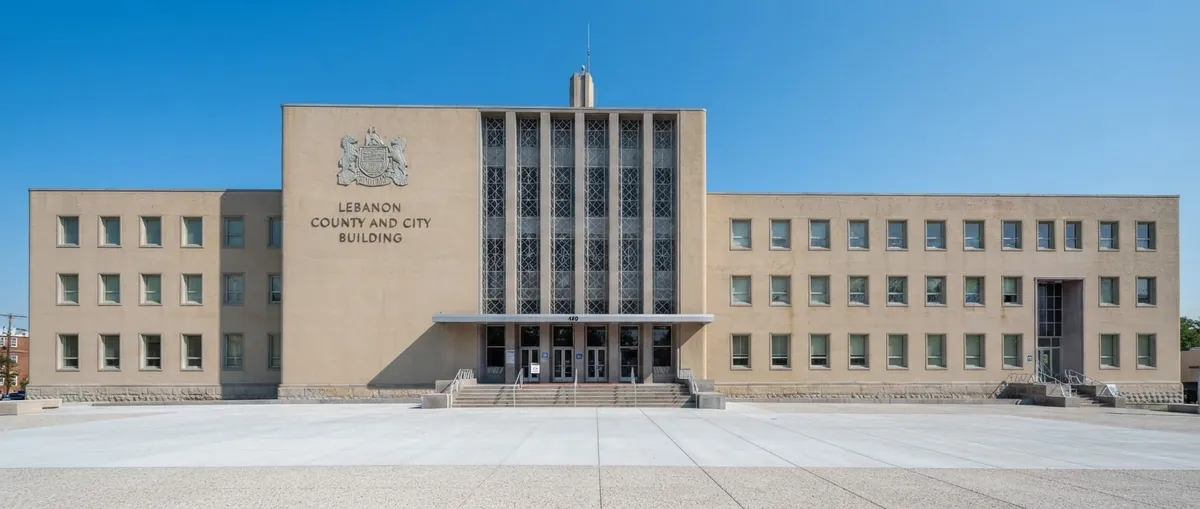
Court records of Lebanon County, Pennsylvania, are maintained by the Clerk of Courts and the Prothonotary's Office and are accessible through online tools, official court portals, and directly at the office. LebanonCourt.us will help you find public information about the court records of this county. Additionally, you can use the UJS portal of the Unified Judicial System of Pennsylvania, contact the Clerk of Courts, or visit the county municipal building in person.
Lebanon Court System Overview
Lebanon County is part of the 52nd Judicial District of Pennsylvania, which exclusively serves this county. The primary court of general jurisdiction is the Court of Common Pleas of Lebanon County, which hears criminal, civil, family, and other cases. Magisterial District Judges operate at the local level, handling minor cases, preliminary hearings, and traffic violations. The court operates in the county municipal building.
Detailed information about the court can be found on the Lebanon County page on the Unified Judicial System of Pennsylvania's website.
Courts Serving Lebanon
Court of Common Pleas of Lebanon County (52nd Judicial District)
Magisterial District Courts
Several magisterial district courts operate in Lebanon County, serving various municipalities. Contact information for a specific magisterial court can be found through the UJS portal.
United States District Court — Middle District of Pennsylvania
Lebanon County belongs to the Middle District of Pennsylvania for federal cases, including bankruptcy cases.
What Types of Cases Lebanon Courts Hear
The courts of Lebanon County hear a wide range of cases:
- Criminal cases: felonies, misdemeanors, infractions
- Civil lawsuits, including small claims cases
- Family law: divorce, custody, support, protective orders
- Probate matters: inheritance, guardianship, trust management
- Juvenile cases
- Adoption and termination of parental rights
- Traffic violations and DUI
District Court Cases in Lebanon
The Court of Common Pleas is the county's court of general jurisdiction. Serious criminal cases are heard here after preliminary hearings in the magisterial court. Civil lawsuits exceeding the magistrate's jurisdiction are also heard here. Appeals from magisterial judges' decisions are filed with the Court of Common Pleas.
Cases are distributed among the judges of the Court of Common Pleas. Criminal cases are managed by the Clerk of Courts, and civil cases by the Prothonotary's Office. Post-conviction proceedings and motions for sentence reconsideration are also handled at this level.
Magistrate Court Cases in Lebanon
Magisterial district judges handle cases that affect the daily lives of most residents. These include traffic violations, DUI cases at the charge stage, minor criminal offenses, and preliminary hearings in serious criminal cases.
Civil claims up to $12,000 fall under the jurisdiction of the magistrate court. Small claims are limited to $12,000 according to Pennsylvania law. Magistrates also issue search and arrest warrants, handle local ordinance violations, and landlord-tenant disputes.
Family Law, Probate, and Juvenile Matters in Lebanon
Family law. Divorce, child custody, support, paternity, and Protection from Abuse orders are handled by the Court of Common Pleas. Claims are filed through the Prothonotary's Office. Since 1804, divorce records in Pennsylvania have been kept in the prothonotary's office of the county where the divorce was granted — more about vital records.
Probate matters. Inheritance, guardianship, and trust management cases are processed by the Register of Wills / Orphans' Court Division at the Court of Common Pleas.
Juvenile cases. Criminal cases involving minors and child protection cases are handled by the Court of Common Pleas through the Clerk of Courts. Juvenile case records are confidential under Pennsylvania law.
How Cases Move Through the Lebanon Court System
- Case initiation. A criminal case begins with a complaint or arrest; a civil case with a claim filed with the Prothonotary's Office; a family or probate case with the appropriate petition.
- Judge assignment. The case is distributed among the judges of the Court of Common Pleas or directed to the magistrate court depending on jurisdiction.
- Initial hearings. In criminal cases — arraignment; in civil cases — scheduling conference.
- Pre-trial phase. Parties file motions, exchange evidence (discovery), negotiate plea deals or settlements.
- Trial or resolution. The case concludes with a verdict, plea deal, settlement, or default judgment.
- Post-judgment. Sentencing, appeal to the Superior Court of Pennsylvania, or enforcement of judgment.
Court Administration, Local Rules, and Public Access in Lebanon
The administration of the courts of the 52nd Judicial District is carried out by the administrative judge of the Court of Common Pleas and the court administrator. Local court rules are available on the Lebanon County page of the Unified Judicial System.
Regarding public access: most court records in Pennsylvania are public according to the Public Access Policy of the Unified Judicial System. There are exceptions — juvenile records, sealed cases, and some family cases have restricted access. The Public Records page explains the general access rules.
Hearings are usually held in person at the municipal building. For remote participation options, it is advisable to check directly with the court office at (717) 228-4419.
The Lebanon County Sheriff's Office provides court service, warrant execution, and civil process.
Court Records and Related Court Resources in Lebanon
- Case search (docket sheets). Free case information search is available through the UJS Case Search portal. Here you can find information on criminal, civil, and other cases, including docket sheets.
- Clerk of Courts. The Clerk of Courts maintains records in criminal and juvenile cases. All records are available to the public unless otherwise provided by law.
- Prothonotary's Office. The Prothonotary's Office is the main office for civil, family cases, and court judgments.
- Forms and documents. Application forms and documents are available on the forms page of the county's official website.
- Criminal history check. The PATCH (Pennsylvania Access to Criminal History) system can be used to obtain a criminal history check. You can also request through the Pennsylvania State Police.
- Inmate search. To search for individuals in state correctional facilities, use the Inmate Locator of the Department of Corrections or the search page on the state website. Information about the Lebanon County Correctional Facility can be found on the county's website.
- Sex offender registry. The Megan's Law registry is available on the Pennsylvania State Police website.
- State police reports. Public Information Release Reports are published by the Pennsylvania State Police divisions.
- Property records. The Recorder of Deeds maintains records of property transfers in the county.
For general questions about the county, visit the official Lebanon County website. Quick access to court record information is also available on LebanonCourt.us.